Do You Really Know What You Sign? How Transaction Simulation Changes the Risk Math for DeFi Power Users
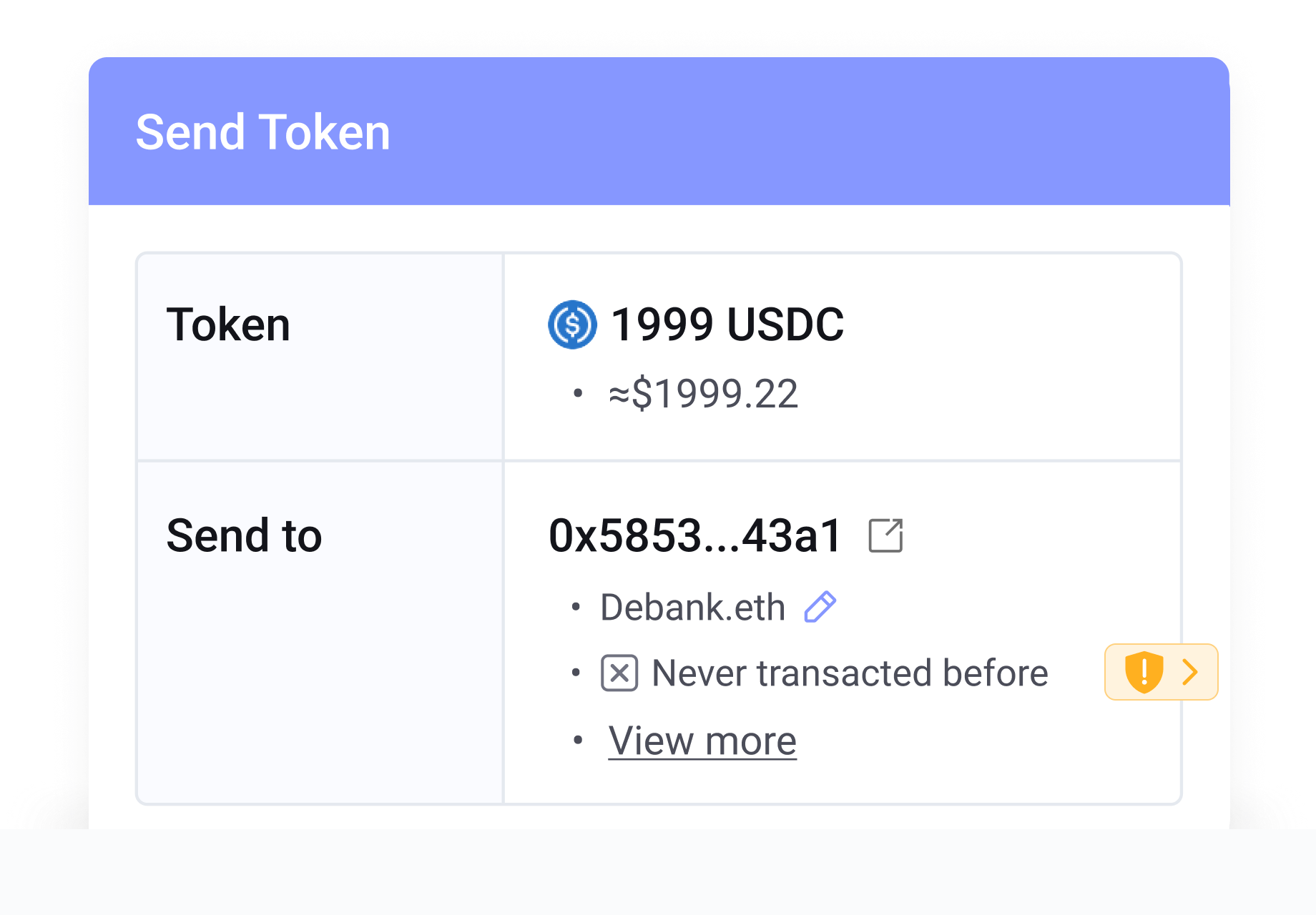
Why do so many sophisticated DeFi traders still "blind sign" transactions? The conventional answer — speed and convenience — is incomplete. The deeper reason is cognitive: signing dialogs from wallets are abstractions, not decoded financial statements. They show amounts and gas numbers but rarely translate a smart contract call into the exact token movements that will occur. Transaction simulation is the mechanism that closes that gap: it runs a dry-run of a transaction against a recent chain state and presents estimated token balance changes, fee costs, and common red flags before you hit confirm.
This article examines how transaction simulation works, why it matters for multi-chain, high-volume users in the US market, where it fails, and how a wallet like rabby wallet implements it as part of a broader security posture. I’ll compare the approach to alternatives, correct three common misconceptions, and end with decision heuristics you can use when evaluating wallets and protecting smart capital.
Mechanism: What transaction simulation actually does (and how)
At its core simulation is a deterministic state transition: given the current ledger state and a transaction (call data, gas limit, gas price, sender nonce), the node or simulation engine executes the transaction in a sandbox without broadcasting it. The engine uses the same EVM semantics that would run on-chain, returning post-execution balances, emitted events, and any revert reasons. That raw result is then translated into a human-readable summary: "You will receive 12.345 ABC; you will spend 0.01 ETH in gas; this call will change approval for TOKEN-X to unlimited."
Key implementation choices matter. Some wallets run simulations locally using the connected node; others route simulation requests through their own backend service that calls multiple nodes and enriches results with off-chain threat intelligence (known-hacked contracts, abnormal approval patterns, DNS/ENS checks). The latter improves coverage and speed for multi-chain setups but introduces trust and privacy trade-offs: you gain richer warnings but expose the transaction payload and possibly your activity fingerprint to the simulator service.
Why it matters for DeFi power users
Power users operate across many chains (Rabby's support for over 90 EVM-compatible chains is a direct response to this need) and frequently interact with complex contracts: routers, vaults, lending markets, or multi-step zap contracts. Each of those can include side-effects that are non-obvious from an on-screen amount. Simulation converts opaque contract logic into concrete token deltas and fee estimates — the exact things that determine whether a trade executes as intended or your approval grants unlimited token spend to an unknown contract.
For US-based traders the stakes include regulatory and tax visibility (knowing exact token flows helps with accurate realized gains calculations) and operational risk (speedy, correct error detection when networks are congested or front-running is likely). Transaction simulation also reduces a frequent source of loss: approval overload. When you see the simulation say "this call will set allowance to MAX" you can pause and revoke later — a workflow Rabby supports natively with its approval revocation tool.
Trade-offs, limits, and the placebo problem
Simulation is powerful but not magical. There are several practical limits to keep in mind.
1) Time and state drift. Simulations use a snapshot of chain state. If the mempool or liquidity changes between simulation and on-chain inclusion (front-running, sandwich attacks, or rapid price movement), the simulated outcome may differ materially from the executed outcome. Simulation reduces but does not eliminate market risk.
2) Correctness of the model. Some contract behaviors depend on block context (block.timestamp, gasleft, or on-chain randomness). Simulators mimic those but can miss off-chain oracle manipulations or re-entrancy triggered by concurrent transactions. In plain terms: a simulation can tell you "what will happen given world X," but cannot prove opponents won't create world X+1 by racing your tx.
3) Privacy and trust. If simulation runs through a vendor backend, you trade improved detection for exposure of transaction metadata. For institutions, that trade-off can be unacceptable unless the provider has strong confidentiality controls (e.g., on-premise or audited dark-pool-like sims). Rabby navigates this with an open-source client and integrations that let users pair hardware wallets and institutional custody (Gnosis Safe, Fireblocks), limiting single-point data leakage.
4) Coverage gaps. Simulation engines are only as aware as their threat intelligence. Known-hacked-contract databases, heuristics for suspicious approvals, or receiver address checks will catch many problems — but brand-new exploits and subtle logic flaws can still slip through. The 2022 Rabby Swap incident is a concrete reminder: the team mitigated damage, compensated users, and increased audits afterward, but the event shows that tools and human process must co-evolve.
Comparing approaches: Rabby vs MetaMask vs Coinbase Wallet
Three reasonable choices occupy the EVM wallet landscape, and each makes different trade-offs.
– MetaMask: ubiquitous, well-integrated, and a de facto standard. It offers broad dApp compatibility but historically emphasized convenience. Simulation capabilities are limited unless layered with third-party tools. For traders who prize universality and the largest extension ecosystem, MetaMask remains attractive—but you may need add-ons or external services for the level of pre-signature inspection power that simulation provides.
– Coinbase Wallet / Trust Wallet: custodial-adjacent conveniences with simpler UX and fiat rails in Coinbase’s broader product suite. They reduce friction for on-ramping fiat but offer less explicit pre-transaction simulation or approval revocation depth. For users whose priority is fast fiat entry and custodial recovery options in the US, these are pragmatic choices; for trust-minimizing DeFi strategies they are less suitable.
– Rabby Wallet: positions itself for power users by embedding simulation and pre-transaction risk scanning into the signing flow, automating network switching, supporting hardware wallets and multisig, and adding a native approval revocation UI. The wallet’s open-source MIT license increases auditability. The trade-off is that Rabby does not provide an integrated fiat on-ramp or in-wallet staking — two convenience features some traders expect from wallet ecosystems in the US market.
Three common misconceptions — corrected
Misconception 1: "Simulation guarantees safety." Correction: simulation reduces many classes of error (blind approvals, obvious token drains) but cannot prevent race conditions or novel exploits that depend on off-chain manipulations. Treat it as a strongly informative defense layer, not an oracle of invulnerability.
Misconception 2: "Simulation is only for beginners." Correction: institutions and high-frequency traders benefit most because they frequently interact with complex contracts and cross-chain bridges. Simulation saves time and loss potential by surfacing subtle side-effects before capital moves.
Misconception 3: "All simulations are equally private." Correction: privacy depends on where simulation is executed. Local node simulation preserves privacy but may be slower or less enriched. Vendor-backed simulations add intelligence but create metadata exposure. Decide based on threat model and operational constraints.
Decision heuristics: When to trust a simulation and when to add friction
Use these practical rules when a signing prompt appears:
– If simulation shows "approval to MAX" for any token: stop and convert that approval into an exact-amount approval, or schedule revocation immediately after the operation.
– If simulation shows large balance deltas or unexplained token movements: do not sign until you (a) review the contract source and (b) validate via a block explorer or a second node provider.
– If you are performing cross-chain swaps or bridging funds and the simulation includes external bridge calls, increase gas and monitoring margins: bridges frequently change state between snapshots.
– Institutions: require simulation logs be retained and correlated with custody signatures. Rabby’s integrations with Gnosis Safe and enterprise custody providers make this workflow practical.
Where this could go next — conditional scenarios to watch
Scenario A — richer, decentralized simulation: If simulation engines become fully decentralized and reputably distributed across node operators, the privacy-versus-intelligence trade-off weakens. That would let wallets offer high-fidelity simulation without vendor metadata leakage. Signals to watch: open-source simulator projects, multi-node attestations, and community-run reputation oracles.
Scenario B — regulatory pressure on analytics vendors: In the US, growing scrutiny of on-chain analytics providers could constrain vendor-hosted simulation services that retain user-level data. Wallets that rely on third-party enrichment could face compliance or privacy limitations, pushing more logic to client-side or institutional proxies.
Both outcomes are plausible; which one arrives first will depend on incentives — commercial analytics margins versus user demand for privacy — and on how quickly open-source communities produce robust, audited simulation stacks.
FAQ
What is the single most effective thing I can do to avoid blind-signing losses?
Require a simulation summary before signing any transaction that involves approvals, large amounts, or cross-chain operations. If the wallet does not show exact token flows and approval changes, pause and either simulate locally with your node or use a wallet that provides clear, pre-sign simulation output.
Does simulation replace hardware wallets and multisig?
No. Simulation is complementary. Hardware wallets protect private keys; multisig splits authority. Simulation inspects intent and outcome. Combining all three creates layered defenses: key protection, operational checks, and outcome verification.
How private are simulations in Rabby?
Rabby is open-source and supports local flows, hardware wallets, and enterprise integrations that reduce single-point exposure. If you use vendor-backed enrichment, expect some metadata disclosure; if privacy is paramount, run simulations against your own node or restrict third-party features.
Will simulation stop front-running?
Not by itself. Simulation helps you detect risky calls, but front-running is a race problem in the mempool. To mitigate it use private relay options, limit slippage, or use tools that submit via private RPCs; simulation is one detection layer, not a timing cure.
Transaction simulation is now a baseline expectation for any wallet aimed at power users. It translates opaque contract calls into concrete, auditable token deltas and exposes many otherwise-hidden risks. But it introduces trade-offs — privacy, residual race risk, and coverage limits — that every sophisticated user must weigh. For those who want a multi-chain, simulation-first browser extension with built-in revocation, hardware-wallet and multisig compatibility, and automated network switching, exploring options like rabby wallet alongside careful operational rules will sharpen your defenses against the kinds of losses that still scare the DeFi community.